

Xi Jinping's plan for global AI governance
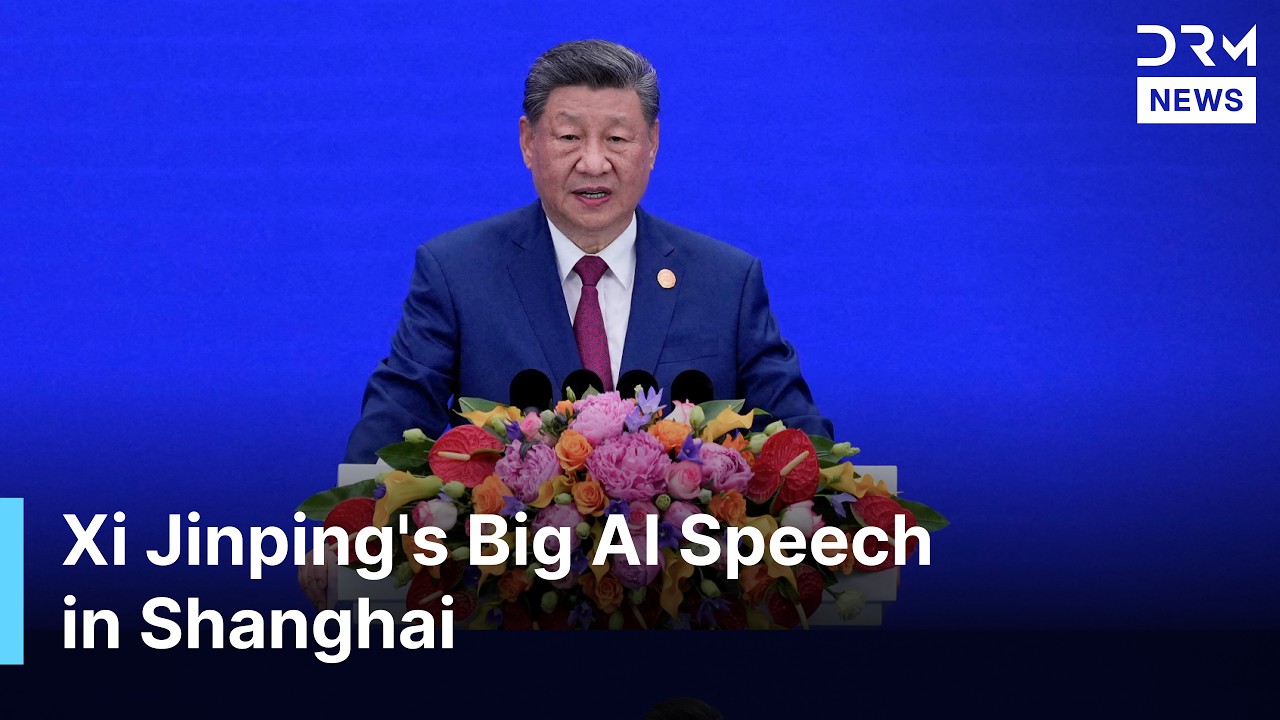
This video records Xi Jinping's keynote at the 2026 World Artificial Intelligence Conference in Shanghai. He discusses industrial adoption, open development, safety controls, cultural diversity, international governance, and access to AI.
1. Seventy years of AI, followed by four governance questions
Section 01Xi began with the 1956 Dartmouth workshop, where artificial intelligence took its name. He compared AI with steam power, electricity, and the internet in their capacity to change work, daily life, and economic development.
He asked how humans should live with thinking machines, how algorithms can take part in decisions safely, how governance should handle ethical problems, and how AI can reach everyone while the divide grows. His answer was a people-centered system based on shared prosperity, common security, and international coordination. The written Dartmouth proposal used the term on August 31, 1955, before the workshop.
2. Open development and industrial use
Section 02Xi called for open source, collaboration, sharing, and AI use across traditional, emerging, and future industries. He described AI as moving from the digital world into physical systems.
He did not define open source. The Open Source AI Definition 1.0 requires the freedom and materials needed to use, study, modify, and share a system. Downloadable weights may fail that test. China's AI Plus guideline covers industry, science, consumption, public services, governance, and international cooperation. Its adoption targets do not prove that every sector benefits.
3. Security controls and national-security limits
Section 03Next came laws, technical monitoring, early warnings, emergency response, safeguards against malicious use, and human control. Xi also objected to stretching national-security claims or placing one country's security above another's.
China regulates public generative-AI services through measures in force since August 2023. The United States still licenses advanced chip exports to China; its January 2026 policy moved some products to case-by-case review. China also controls technology exports. The dispute concerns how far those controls should reach.
4. Cultural diversity
Section 04AI should not erase national cultures or the diversity of civilizations, Xi said. He wanted systems shaped by common human values and used for understanding, exchange, and tolerance.
UNESCO's AI ethics recommendation calls for multilingual, locally relevant systems and protection of cultural diversity. UNESCO reports that only a minority of responding states train systems in all official languages. Fewer cover Indigenous languages or support AI policies for cultural heritage.
5. UN-centered governance and Global South capacity
Section 05Xi placed the United Nations at the center of global coordination. He called for aligned strategies, rules, and technical standards, plus capacity building for Global South countries.
Resolution 78/311 covers AI capacity building. The Global Digital Compact addresses digital divides and AI governance. A scientific panel and Global Dialogue followed. These bodies convene, study, and advise. They cannot enforce global rules.
6. China's domestic program
Section 06Xi linked China's 2026–2030 plan to AI Plus, industrial use, and domestic rules. He said the core smart-economy industries were worth at least RMB 1 trillion and called intelligent manufacturing part of Chinese modernization.
The National People's Congress approved the plan in March 2026. A separate official statistic put China's narrower core AI industry above RMB 1.2 trillion in 2025. The categories may differ. The speech gave no method or reference period for its RMB 1 trillion figure. Existing rules and a 2026 ethics-review guideline do not prove that Chinese AI is always safe or controllable.
7. A new cooperation organization
Section 07Xi listed earlier Chinese governance and capacity-building initiatives, then presented the World Artificial Intelligence Cooperation Organization, or WAICO. He described the Shanghai-based body as a way to support development, governance, and Global South capacity.
Twenty-nine countries signed WAICO's founding agreement on July 16. The agreement describes an independent intergovernmental organization headquartered in Shanghai. Treaty entry into force, staffing, and results come later. WAICO is not a UN body.
8. Three commitments
Section 08China pledged 5,000 AI training and seminar opportunities over five years. It would also develop application centers with ASEAN, the League of Arab States, the African Union, CELAC, the Shanghai Cooperation Organization, and BRICS, and enable 30 countries to use the MAZU meteorological warning system.
The speech named no recipients, budgets, locations, schedules, or evaluation methods. China's meteorological agency launched MAZU in 2025 and reports several pilots. Thirty national deployments are not complete.
9. Human control and cooperation
Section 09Xi closed with precise oversight, human control, international consensus, and practical cooperation. Governance should keep pace with AI and prevent loss of control, he said.
He defined no control test, audit process, enforcement body, or division of authority. Model evaluations, open-weight policy, export controls, and jurisdiction remain disputed. The institutions and pledges now face implementation.