Thumbnail for The open weights debate (3D Chess)
publication

The open weights debate (3D Chess)

Kimi K3 turns open weights into a conflict between frontier-lab economics, national security, Chinese industrial strategy and broad access to intelligence.

  • Capital, Markets, And Business Models
  • Open Models
  • Policy, Governance, And Geopolitics

Source thumbnail for NVIDIA’s Central Bank of AI
recap

NVIDIA’s Central Bank of AI

This is a SemiAnalysis Weekly panel with Jordan Nanos, Dan Nishball, Zane Fong, and Kang Wen Cheang about financing AI infrastructure. It covers the capital–offtake–data-center trinity, NVIDIA’s GPU debt backstops, neocloud lending, and the token economics beneath the buildout.

  • AI Infrastructure, Compute, Chips, And Energy
  • Capital, Markets, And Business Models
SemiAnalysis
Source thumbnail for Sam Altman — How to Start a Startup
recap

Sam Altman — How to Start a Startup

This is Ti Morse’s July 2026 Relentless interview with OpenAI CEO Sam Altman about building startups and operating OpenAI. They discuss AI-era company formation, founder psychology, execution, compute, OpenAI’s evolution, product design, leadership, and durable shifts in user behavior.

  • Agents
  • AI Infrastructure, Compute, Chips, And Energy
  • Capital, Markets, And Business Models
Sam Altman / Relentless
Source thumbnail for Kimi K3 Is the Best Model Ever Made — Sometimes
recap

Kimi K3 Is the Best Model Ever Made — Sometimes

This is Theo Browne’s hands-on video review of Moonshot AI’s Kimi K3 after a day spent pushing the model through coding, frontend, 3D, research, security, and multi-agent work. It covers why K3 feels like a frontier-class open-weight release, the architecture and economics behind it, the work it did well, and the rough interaction layer behind the “sometimes” in Theo’s title.

  • Agents
  • AI Infrastructure, Compute, Chips, And Energy
  • Frontier Models And Capabilities
  • Open Models
Theo - t3․gg
Source thumbnail for Poolside Co-Founder Explains Frontier Open-Weight Models
recap

Poolside Co-Founder Explains Frontier Open-Weight Models

This 34-minute Baseten interview with Poolside co-founder Eiso Kant explains Laguna S 2.1 and Poolside's push to keep frontier model weights open. Gavin Baker's response, Jason Warner's launch post, and Poolside's release article cover the architecture, benchmarks, training system, public trajectories, and deployment.

  • Agents
  • AI Infrastructure, Compute, Chips, And Energy
  • Frontier Models And Capabilities
  • Open Models
Baseten
Source thumbnail for Poolside’s Model Factory, Laguna S, Open Models, and the Race to AGI
recap

Poolside’s Model Factory, Laguna S, Open Models, and the Race to AGI

This is a Latent Space interview with Poolside co-founder and co-CEO Eiso Kant, supplemented by Poolside’s July 21, 2026 Laguna S 2.1 release article. It covers Poolside’s origin, Model Factory, Laguna models, reinforcement learning, systems engineering, open models, regulation, financing, and AI-native engineering teams.

  • Agents
  • AI Infrastructure, Compute, Chips, And Energy
  • Frontier Models And Capabilities
  • Open Models
Latent Space
Source thumbnail for Who’s Afraid of Chinese Models?
recap

Who’s Afraid of Chinese Models?

This is Ben Thompson’s July 20, 2026 Stratechery analysis of Chinese open-weight AI models. It covers inference economics, frontier-lab strategy, China’s industrial policy, distillation, and cybersecurity.

  • Capital, Markets, And Business Models
  • Frontier Models And Capabilities
  • Open Models
  • Policy, Governance, And Geopolitics
Ben Thompson / Stratechery
Source thumbnail for Kimi K3: The open-weights escalation
recap

Kimi K3: The open-weights escalation

Nathan Lambert argues that Kimi K3 makes frontier open weights credible, pressuring closed-lab economics while forcing a harder global policy and risk-management problem.

  • Capital, Markets, And Business Models
  • Frontier Models And Capabilities
  • Open Models
  • Policy, Governance, And Geopolitics

Nathan Lambert
Thumbnail for Why We May Never ‘Solve’ Continual Learning
publication

Why We May Never ‘Solve’ Continual Learning

Continual learning may not be one problem with one solution. The challenge has changed from catastrophic forgetting in early neural networks to post-training, deployment learning, weight updates, and architectures built around experience.

  • Agents
  • Frontier Models And Capabilities
Source thumbnail for AI Sputnik Moment: Kimi K3
recap

AI Sputnik Moment: Kimi K3

Kimi K3 reached the frontier on price and capability, while several claims about its rank, open weights, training economics, talent flows, forecasting, and screening outran the available evidence.

Peter H. Diamandis
Source thumbnail for Conversation With Baseten's Head of Training
recap

Conversation With Baseten's Head of Training

Charles O'Neill argues that teams should prove a task with a strong hosted model, then use post-training and open weights when proprietary feedback, control, cost, or latency justify specialization.

  • AI Infrastructure, Compute, Chips, And Energy
  • Open Models
Baseten
Source thumbnail for 6 months to live for open models
recap

6 months to live for open models

Nathan Lambert warns that open models could soon trigger restrictions shaped by frontier review and distillation policy, while current U.S. policy still supports open-source adoption.

Nathan Lambert
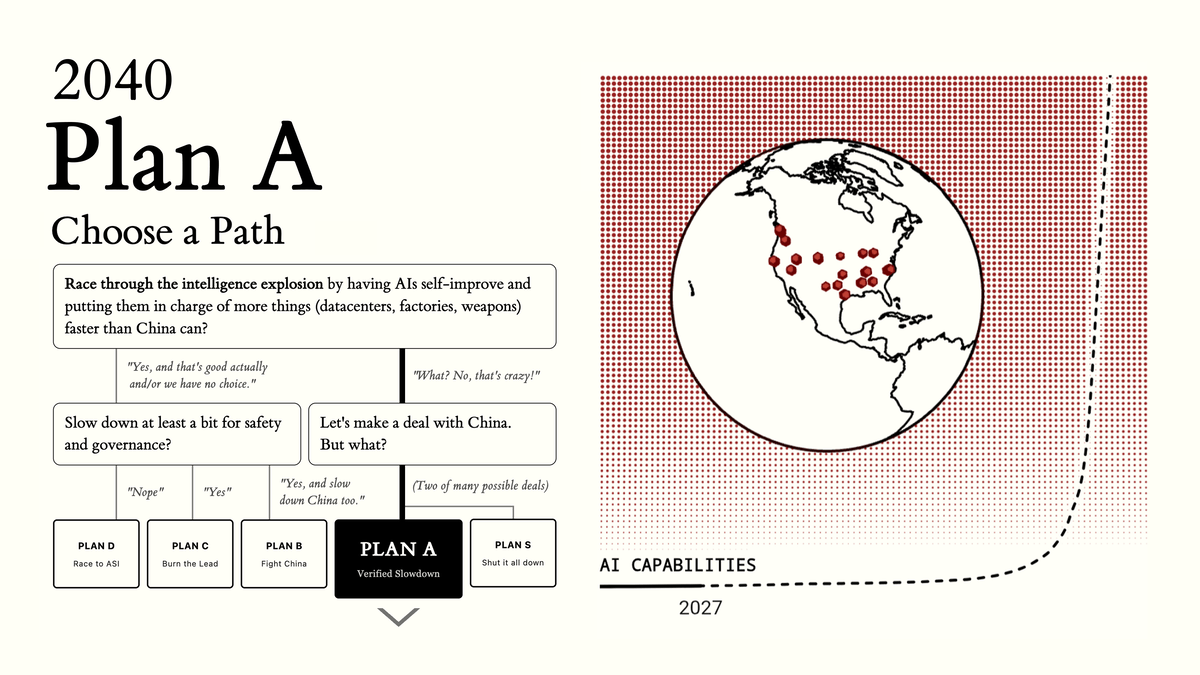
Source thumbnail for AI 2040: Plan A
recap

AI 2040: Plan A

AI Futures Project proposes a verified US-China deal that opens frontier AI research, controls compute, pauses at top-expert AI, and delays superintelligence until 2040.

  • AI Infrastructure, Compute, Chips, And Energy
  • Frontier Models And Capabilities
  • Jobs, GDP, And Economic Growth
  • Policy, Governance, And Geopolitics
AI Futures Project
Source thumbnail for Bryan Catanzaro On Why NVIDIA Builds Nemotron
recap

Bryan Catanzaro On Why NVIDIA Builds Nemotron

  • Agents
  • AI Engineering, Software, And Developer Tooling
  • AI Infrastructure, Compute, Chips, And Energy
  • Capital, Markets, And Business Models
  • Frontier Models And Capabilities
  • Jobs, GDP, And Economic Growth
  • Open Models
  • Policy, Governance, And Geopolitics
The MAD Podcast
Source thumbnail for Lilian Weng Explains Why Scaling Laws Need Careful Accounting

recap

Lilian Weng Explains Why Scaling Laws Need Careful Accounting

Picture a mouse beside an elephant. The elephant burns more energy overall, but not as much as you would expect from its size. Pound for pound, the mouse burns energy much faster. In biology, that relationship follows a scaling law: as body size rises, metabolism rises too, but more slowly than body weight. Language models have their own version. Make the model bigger, train it on more text, and spend more GPU time, and it usually gets better at predicting the next piece of text. The error does not fall randomly. It tends to fall along a predictable curve. Labs use that curve before they spend billions on a bigger run. They train small models first, then ask: should the next run buy more parameters, more tokens, or more compute? Kaplan looked at small transformer runs and said: when compute goes up, grow the model much faster than the data. Chinchilla ran more than 400 experiments and said: many big models needed far more tokens. In Lilian Weng's "Scaling Laws, Carefully" article, she explains why the answer is not fixed. These curves come from smaller test runs. If you count the model size differently, round the error number, or use a different set of test runs, the curve can move. Then the advice changes: build a bigger model, use more text, or spend the compute differently.

  • AI Engineering, Software, And Developer Tooling
  • AI Infrastructure, Compute, Chips, And Energy
  • Capital, Markets, And Business Models
  • Frontier Models And Capabilities
Lilian Weng
Source thumbnail for Stephen Balaban on the energy-to-tokens machine behind AI compute
recap

Stephen Balaban on the energy-to-tokens machine behind AI compute

Stephen Balaban starts the story before the GPU. In Matt Turck's interview, Lambda's co-founder and CTO says the clean way to think about AI compute is to put energy production on the left and tokens on the right. Photons from the sun, or molecules of natural gas, become electrical power. The data center consumes those watts, spends some of them cooling itself, and feeds the rest into servers, networking, and storage. That hardware produces FLOPS. Model builders consume those FLOPS for training and inference. Then the FLOPS become tokens per second, and the application tries to turn those tokens into useful intelligence. That is why a customer does not log into an AI cloud and buy a loose GPU off a shelf. After the energy reaches the rack, Balaban says the hard part is turning the chips into a real cloud service. He asks listeners to imagine a 10,000-GPU cluster. Then the work begins. The cluster needs storage fast enough for model data. It needs CPU servers to orchestrate jobs. It needs one network for ordinary traffic, another for monitoring, and a compute fabric where GPUs can move model weights and activations between machines. When Lambda partitions that system for a customer, all of those layers have to move together. Balaban calls it an immense software undertaking, and says many neoclouds have not made the investment needed to run a real cloud service. That is the GPU myth. The product is not the chip. The product is the machine that makes the chip usable.

  • AI Infrastructure, Compute, Chips, And Energy
  • Capital, Markets, And Business Models
The MAD Podcast
Source thumbnail for From AGI to ASI
recap

From AGI to ASI

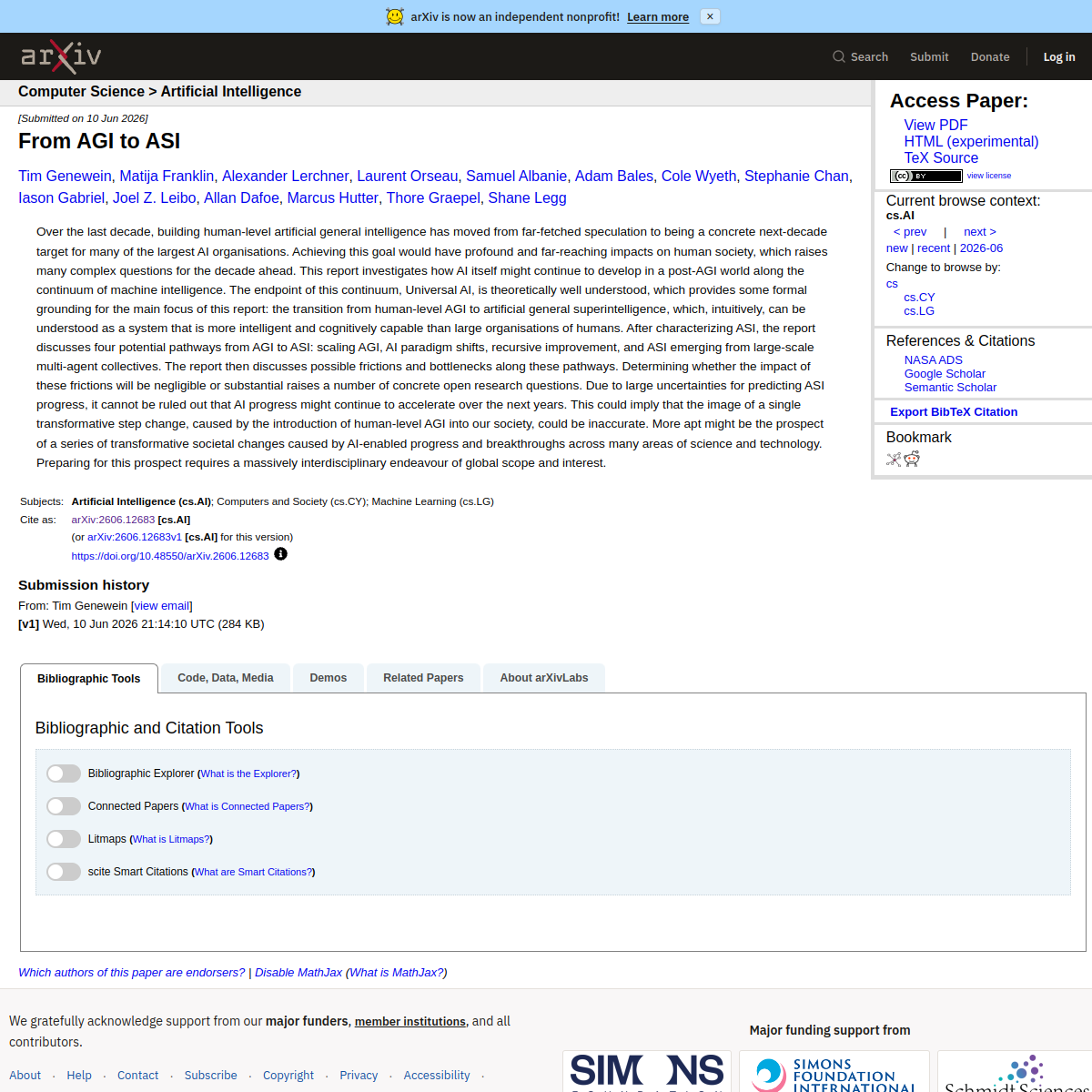
A Google DeepMind-led report asks what happens if AI reaches roughly human-level general intelligence and keeps improving. It defines artificial general superintelligence as broad capability beyond large, coordinated groups of experts. The authors map four routes: continued scaling, new algorithms, recursive improvement, and coordinated AI collectives. Each route faces limits they cannot yet size.

  • Frontier Models And Capabilities
Google DeepMind
Thumbnail for Allocatoor Daily Issue #5, June 9, 2026
publication

Allocatoor Daily Issue #5, June 9, 2026

This issue covers four linked feature recaps: Satya Nadella on enterprise AI harnesses, Tyler Cowen on initiative as the deployment bottleneck, Demis Hassabis on the AI decision window, and Alex Imas with Philip Trammell on who owns the upside if AI shifts returns toward scarce assets. It compresses about 3 hours and 13 minutes of primary source video into a 14 minute daily review.

Thumbnail for Can Models Prove Their Own Work?
publication

Can Models Prove Their Own Work?

Models are making it cheaper to generate more attempts: faster kernels, possible protein binders, new data-center demand, and software output from coding agents. The harder question is whether models can prove their own work, or where tests, labs, buyers, infrastructure, and human judgment still have to decide what is real.

Amazon Web ServicesAnthropicNVIDIA
Thumbnail for AI’s New Cost Curve
publication

AI’s New Cost Curve

AI is shifting scarcity from raw capability to the costs around it: inference budgets, chip data movement, reliable evaluation, durable memory, human supervision, capital substitution for labor, and weak-link institutions. This issue maps where leverage moves once models become useful enough that the hard question is no longer only what they can do, but who can allocate the remaining compute, trust, context, labor, power, and access.

Amazon Web ServicesGoogle CloudLatent.Space
Thumbnail for Who owns the bottleneck?
publication

Who owns the bottleneck?

AI is moving from model competition into an allocation stack: compute, wafers, power, deployment capacity, inference speed, trusted workflows, distribution surfaces, and capital markets.

Alex ImasAmazon Web ServicesDylan Patel