

Jaya Gupta on How Shared AI Can Turn Institutional Know-How Into an Industry Baseline
- AI For Science
- Capital, Markets, And Business Models
- Policy, Governance, And Geopolitics
Where your work is generic, pool it and take the gain, because there you are protecting mediocrity. Where your people's judgment is the product, keep it off the shared model.
Intro
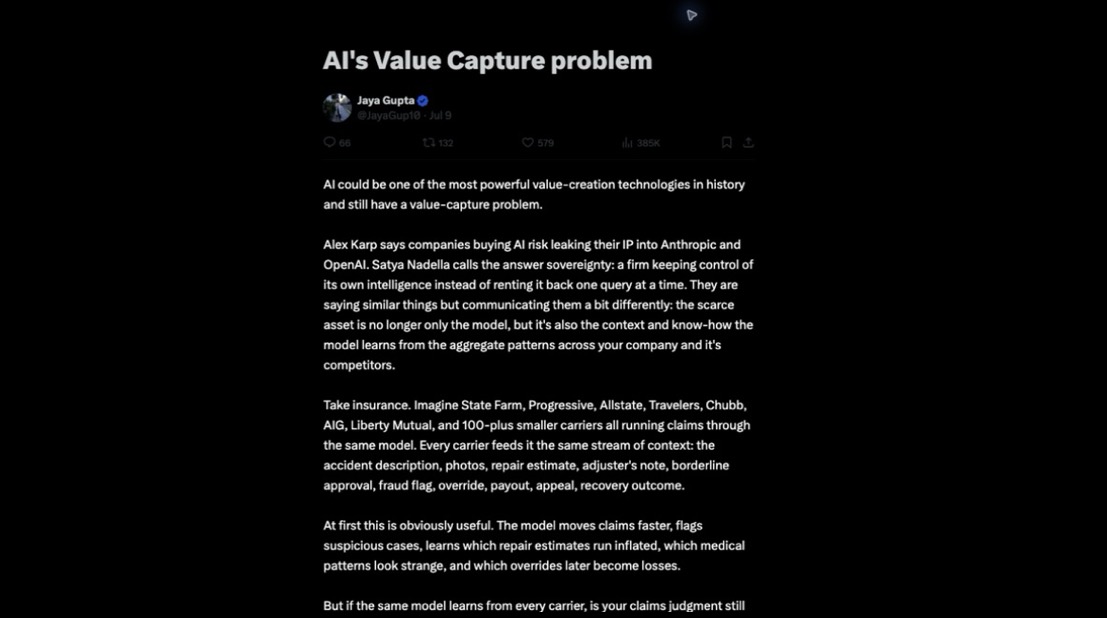
In an X article, Jaya Gupta argues that shared AI systems can turn a company's hard-won institutional judgment into a common industry baseline. She discusses why the core risk is not just data leakage, but surrendering the learning loops that create competitive advantage.
When you use a service like YouTube or Google or TikTok, it feels like you are the customer. But you are not the customer. You are the data which feeds the machine—every video you watch, every action of consumption teaches the algorithm—actions which are then sold back to the advertisers and used to further hook the next user.
Ever since the Alex Karp blow-out, so many have jumped on the "data sovereignty" bandwagon.
But the real concern is not "data leakage"—it's entire industries handing over more nuanced industry intuition—the learning loop.
Intro
Section 01- In an X article, Jaya Gupta argues that shared AI systems can turn a company's hard-won institutional judgment into a common industry baseline. She discusses why the core risk is not just data leakage, but surrendering the learning loops that create competitive advantage.
- When you use a service like YouTube or Google or TikTok, it feels like you are
- the customer. But you are not the customer. You are the data which feeds the
- machine—every video you watch, every action of consumption teaches the
- algorithm—actions which are then sold back to the advertisers and used to
- further hook the next user.
- Ever since the Alex Karp blow-out, so many have jumped on the "data
- sovereignty" bandwagon.
- But the real concern is not "data leakage"—it's entire industries handing over
- more nuanced industry intuition—the learning loop.
Ideas

Route Workflows by Whether Competitor Learning Would Erase the Edge
IdeaGupta recommends using shared models for generic work while isolating workflows where employee judgment is the product, using competitor learnability as the routing test.
Workflow-routing rule — paragraphs 19 and 24Institutional Judgment Is Part of the Product
IdeaGupta argues that a firm's hard-won judgment—exceptions, overrides, fraud instincts, and ways of reading ambiguity—is operating intellectual property that a widely shared AI capability can make less scarce.
Insurance example — paragraphs 5–8Data Rights Are Not the Same as Learning Rights
IdeaGupta argues that retention, confidentiality, access controls, and training opt-outs do not fully answer who controls the tasks, evals, workflow traces, corrections, failure patterns, and job logic discovered while building AI systems.
Learning-rights distinction — paragraph 17The Best Firms May Contribute the Unique and Receive the Average
IdeaThe article says a shared AI service can be a bad trade for an above-average firm if it contributes differentiated judgment but receives a capability blended toward the market average.
Unique-versus-average exchange — paragraph 16
Tags
- AI Economics
- Enterprise AI Adoption
- AI Distribution And Markets
- Enterprise AI Platforms
- AI Policy And Governance
- Frontier Lab Business Models
- Workflow Automation
- AI For Biology