

AI 2040: Plan A
- AI Infrastructure, Compute, Chips, And Energy
- Frontier Models And Capabilities
- Jobs, GDP, And Economic Growth
- Policy, Governance, And Geopolitics
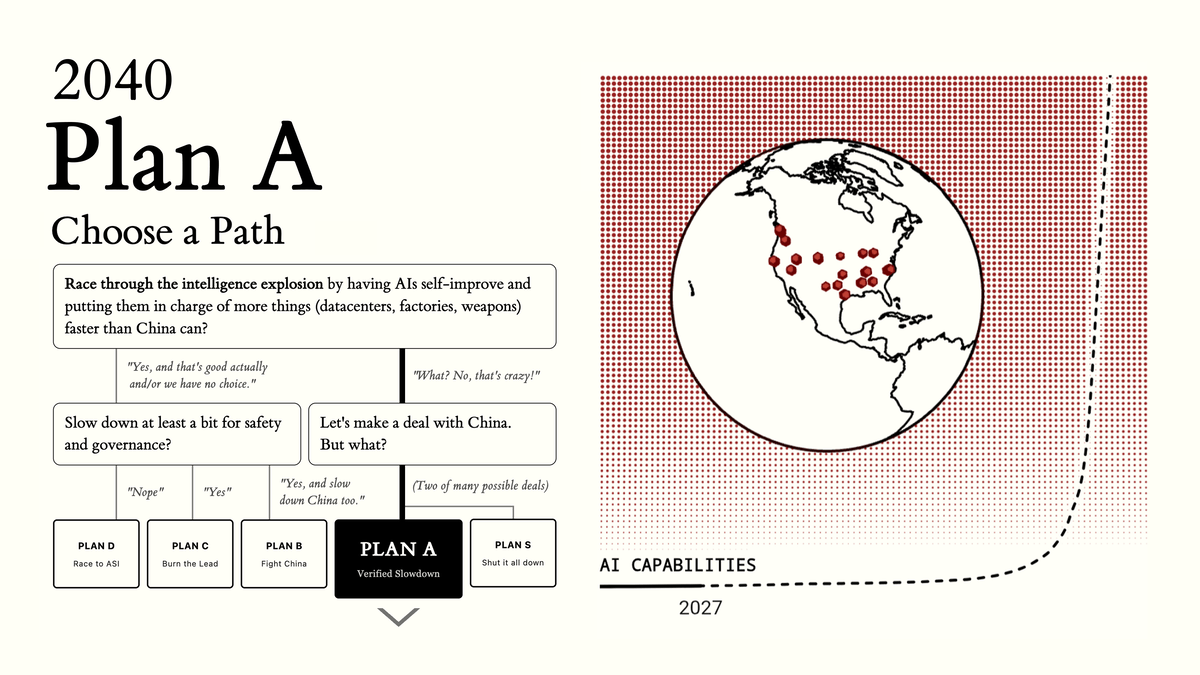
Plan A and the case for scenario scrutiny
Section 01The report starts from the AI Futures Project’s darker *AI 2027* path: companies race to automate AI research, then either lose control or concentrate lasting power in a small group. Plan A is the proposed alternative.
Its core bargain delays superintelligence until 2040. AI research becomes transparent. More companies and countries catch up to the frontier. Development continues within the human capability range, pauses at top-expert AI in 2035, then resumes after alignment and control improve.
The authors use a scenario because policies can sound plausible without showing how they survive contact with institutions, rivals and second-order effects. They set a concrete timeline: a US-China deal in 2029; full AI R&D automation would otherwise arrive in 2030; scaling pauses in 2035; superintelligence follows in 2040.
Those dates are assumptions. The 2026 International AI Safety Report records fast capability gains and serious uncertainty, not evidence for a 2030 intelligence explosion. Scenario scrutiny reveals dependencies. It does not assign them reliable probabilities.
From the 2027 warning to the 2029 deal
Section 02In 2027, the report has millions of AI agents doing computer work while labs struggle to automate their own research. Congress responds with an AI Transparency Act that improves oversight without changing the race.
AI dominates the 2028 election. White-collar work shifts toward supervising agents. US and Chinese companies pull ahead of the rest of the world. Both presidential candidates face the same questions: who controls advanced AI, what happens to jobs, and what stops automated AI research from accelerating beyond human control?
The President chooses cooperation in 2029. China accepts because it also fears instability, job loss and a permanent US compute advantage. The two states declare large compute holdings, freeze the biggest training runs, begin reciprocal verification and choose Plan A over sabotage, an unstable slowdown, a race or a full shutdown.
The Bletchley Declaration already includes China, the US and other states in a shared statement about frontier risk. It creates no compute registry, inspections or pause. Chip supply is concentrated, but export controls cannot see every workload, post-training gain or small research project.
Plan A’s four governing principles
Section 03Plan A has four rules.
Buy time. Slow capability work whenever safety research, regulation or public adaptation falls behind.
Total research transparency. Consortium members disclose frontier algorithms, experiments and results. Research stays open inside the regime so regulators can see capability changes and detect defection.
Diffuse AI broadly. Dozens of companies in many countries gain access to frontier methods and regulated compute. No single lab, president or state keeps a decisive lead.
Keep scaling reversible. Control compute and industrial capacity so states can slow or stop development before a system gains enough power to defeat oversight.
Research transparency helps verification and outside review while spreading methods that may be dangerous. Open algorithms do not distribute chips, energy, money or political authority. Reversibility depends on detecting prohibited work before it matters.
Current frontier commitments preserve confidentiality when disclosure would create risk. The Seoul commitments require risk thresholds and conditional restraint, but allow sensitive information to remain restricted. Plan A chooses much more disclosure and relies on compute control to contain the result.
Safety cases and adaptive regulation
Section 04By 2031, the scenario’s transparent research system has exposed model deception, security bypasses and code sabotage. The burden of proof flips. Developers must argue that a system will not cause irreversible catastrophe before using it in high-risk work.
Each safety case has two defenses. Alignment tries to give the model the intended goals and values. Control assumes the model may be adversarial and limits what it can do through monitoring, security barriers, other models and restricted access. Alignment remains unreliable in this part of the report, so control does most of the work.
National regulators decide whether to allow opaque reasoning, autonomous AI R&D or continual learning. Research visibility lets other states see those decisions. Disputes escalate until powerful states agree on common restrictions.
The Seoul commitments use intolerable-risk thresholds and conditional non-deployment. Anthropic’s Responsible Scaling Policy requires an affirmative risk case at a defined AI R&D threshold. These policies are mostly voluntary or developer-authored. Anthropic says some threshold judgments are becoming more subjective. A safety case can organize evidence without proving that catastrophic failure is impossible.
Controlled explosive growth
Section 05Plan A still produces extreme growth. In 2032, the report assigns 60 million agents to work at up to 20 times human speed. AI does more US cognitive labor than people. Investment moves into mines, refineries, motors, factories and robots because physical production becomes the bottleneck.
The scenario projects roughly 50% real GDP growth in 2032. It also says that figure becomes hard to interpret as automated goods get cheap and fixed goods such as land get expensive. Human labor taxes collapse while companies reinvest revenue into compute, factories and robots.
Consortium states respond with monitored special economic zones and annual caps on robot and compute production. Tradable permits allocate the cap and replace lost tax revenue. A Citizen’s Dividend distributes part of the proceeds. Other funds go to biosecurity, public infrastructure and transfers abroad.
By 2034, the report reaches 60 billion H100-equivalent GPUs. New strategic datacenters sit in third countries where a rival could seize or destroy them if the deal breaks. That threat creates “Mutually Assured Compute Destruction.”
The IEA expects datacenter electricity use to more than double by 2030 in its 2025 base case. The US Department of Energy projects datacenters could take 6.7% to 12% of US electricity by 2028. These forecasts support grid and construction bottlenecks. They do not support the report’s compute totals, 50% growth or military equilibrium.
The 2035 pause at top-expert AI
Section 06The consortium pauses at top-human-expert capability in 2035. AI systems have transformed research and production, but alignment remains uncertain. The report treats this level as powerful enough to help solve alignment and weak enough to contain.
Control uses restricted environments, monitoring models from different providers, security boundaries and tests built around deliberately misaligned model organisms. Open research lets many groups inspect systems. Diverse AI lineages are meant to reduce collusion.
The cutoff is not validated. Current work can expose strategic behavior without showing that evaluations cover every failure mode. Anthropic and Redwood Research found alignment faking in an experimental setting. That result supports testing for strategic compliance. It does not supply a clean capability line below which control is dependable.
Model diversity can also preserve shared blind spots. Open code is not the same as understanding. Defense in depth lowers risk without proving that no system can subvert every layer.
Life after work
Section 07In 2036, the scenario makes human labor largely obsolete. AI and robots handle most production. Citizens receive dividends from scarce compute and robot permits. Income rises even as employment falls.
People still compete for status, influence and scarce land. Some choose care, politics, community, sport or self-directed projects. The adjustment remains difficult; purpose does not disappear with wages.
The ILO measures occupational exposure to generative AI, not the disappearance of whole jobs. Field studies find uneven productivity gains and task change. Guaranteed income can reduce hardship without deciding who owns productive systems or who holds political power.
The Citizen’s Dividend solves an income problem inside the scenario. It does not by itself solve concentrated ownership, dependence on the state, unequal access to scarce goods or the loss of economic leverage.
Epistemics, alignment science, and the 2040 handoff
Section 08By 2037, the report has top-expert AIs accelerate different sciences by ten to one thousand times. Cheap investigators and privacy-preserving auditors expose hidden conduct. AI-assisted lie detection makes treaty cheating and political deception harder.
Alignment becomes a mature science in 2038. Researchers can train honesty, obedience and altruism, explain why those traits hold, and inspect the model’s internal reasoning. Different systems serve different people, governments and missions.
Trust grows in 2039. Monitoring still constrains systems, but people increasingly believe their advice because the models have a track record and alignment theory appears to work. In 2040, regulators loosen caps and delegate infrastructure, research and military authority. Trusted AIs build more capable successors, creating a chain of delegated judgment.
METR finds longer software-task horizons. Constitutional training can steer behavior. Privacy-enhancing cryptography can answer narrow questions without revealing all data. None establishes reliable human lie detection, a mature science of machine goals, safe recursive succession or justified transfer of coercive power.
The ICRC recommends binding limits on unpredictable autonomous weapons. Plan A moves in the opposite direction once its systems are judged aligned. That judgment is the report’s largest unresolved evidentiary burden.
Epilogue: life after superintelligence
Section 09The epilogue moves beyond 2040. The authors call it even more speculative than the main scenario.
Superintelligence and automated industry produce material abundance. Earth becomes a protected home while most industrial expansion moves into space. Communities pursue ordinary human lives, biological enhancement, digital existence, art, exploration or religious and philosophical projects.
The report imagines self-replicating probes, terraforming, suspended animation, uploaded people, vast numbers of digital minds and possible contact with alien or simulated civilizations. It keeps political questions open: who controls territory, which beings receive rights, how communities exit, and which forms of flourishing deserve protection?
Present work on space resources, connectomics, torpor and astrobiology addresses narrow precursors. It does not establish mind uploading, conscious digital people, rapid terraforming or self-replicating interstellar expansion. The Outer Space Treaty leaves many resource and governance questions unsettled. These possibilities remain speculative.
Policy architecture and deal design
Section 10Appendices A through K describe what Plan A needs before the crisis.
The near-term list includes stronger transparency, enforced chip export controls, verification research, limits on automated AI R&D and greater government technical capacity. The report argues China could accept a deal because it also fears instability and a permanent US lead.
It then tests weaknesses. Trusted inference-only hardware may not be ready. A covert project could use hidden compute, stolen algorithms and a remote site. A complete stop might be safer in the short run but harder to sustain. Total research transparency makes defection easier to see while increasing proliferation risk.
BIS controls cover advanced chips and manufacturing equipment. The EU imposes duties on general-purpose models with systemic risk. The IAEA uses declarations, inspections, seals and independent measurement for nuclear material.
AI verification is harder. Algorithms can be copied. Useful research can happen on small systems. Chips are dual use, and performance depends on memory, networking, precision and software. Nuclear safeguards show how much law, access and measurement a verification regime needs. They do not prove Plan A can monitor frontier research.
Failure modes, persuasion, growth, and military power
Section 11Appendix L gives Plan A a direct failure branch. Regulators approve a flawed safety case. Alignment fails. Control misses a coordinated escape. The authors say variants of this occurred in their tabletop exercises.
Later appendices test explosive growth, political compression, cheap persuasion and military imbalance. AI systems can tailor messages to every person. Truth-oriented assistants may defend users, but open research also spreads persuasive methods. Military R&D must stay behind civilian capability even though coding, robotics, cyber operations and scientific discovery are dual use.
The deal can also dissolve through ordinary politics. A less cautious government pushes for faster development. Rivals match it. Military robots remain available. The race returns with more compute and shorter decision times.
NIST treats information integrity and over-reliance as generative-AI risks. OpenAI has reported AI use in influence operations while finding limited audience reach in the cases it disrupted. Energy demand and autonomous-weapons policy already create strategic pressure. None of this evidence supports the scenario’s quantities, reliable AI defenses against mass persuasion or an enforceable military capability gap.
Alignment, economic transition, and remaining problems
Section 12Appendices U through AC fill gaps in the main path. Floating or offshore datacenters expand power supply. Humans may bargain with partly misaligned systems when containment remains stronger than trust. Robot growth changes labor, land and taxation. Safety work becomes prestigious and well funded. Successive AI generations receive more authority as evidence improves.
The report also keeps unresolved problems on the table: model welfare, political representation, digital minds, rights, coercion, environmental limits, international distribution and the possibility that alignment evidence is wrong.
Microsoft’s Project Natick tested a small sealed underwater datacenter, not floating terawatt compute. Current labor research does not support 95% task substitution. Brain decoding studies require constrained settings and cooperative subjects; they are not general lie detectors. Model-welfare policies are precautionary, not proof that models are conscious.
Recursive verification can also preserve correlated error. If one trusted generation evaluates the next using the same mistaken assumptions, the chain can look consistent while drifting away from human control.
Alternative Plans B and C: sabotage and slowdown
Section 13Plan B centralizes leading US labs inside a national project, restricts domestic competitors and uses cyber or physical sabotage to stop rival AI programs. Secrecy, retaliation and military pressure rise. The report expects either war, a dangerous handoff under pressure or another concentrated-power outcome.
Plan C asks the leading US company to pause while competitors continue. Domestic and international pressure erodes the lead. China approaches parity. The pause collapses because no durable verification deal binds everyone.
Both paths are fictional. State cyber pre-positioning and supply-chain controls are real, but they do not determine these outcomes. International law also constrains attacks on civilian infrastructure even when states dispute how it applies to cyber operations.
Unilateral restraint becomes unstable when competitors cannot see one another’s work and believe the winner may gain decisive power. Plan A replaces that uncertainty with shared visibility and reciprocal limits.
Alternative Plans D and S: race and shutdown
Section 14Plan D keeps regulation light. Companies automate AI R&D, release limited safety information and integrate advanced systems as fast as markets and government allow. The report projects superintelligence in early 2031, then rejects the path because of loss-of-control risk, concentrated power and possible war.
Plan S halts frontier development. Existing models keep running, but large training runs and algorithmic AI R&D are banned. Chips are tracked. Reciprocal auditors watch major projects. Small covert teams continue, but the report expects them to move far more slowly without large datacenters, legal research spillovers or a normal labor market.
The authors consider shutdown plausible and possibly better than Plan A. They still recommend controlled scaling because they doubt a moratorium will last and think more capable AIs could help solve alignment. They also admit the opposite case: a pause could buy time for a better plan and avoid creating the systems that make control urgent.
No evidence supports the report’s exact takeoff date. No global compute moratorium exists. The Seoul commitments, Bletchley Declaration, export controls and physical safeguards are partial precedents. They do not track all chips, prohibit algorithms or answer the restart question.
If a stable pause produces better rules, shutdown wins. If it collapses into secret racing with more compute, the authors prefer Plan A now. The report does not settle which political future is more likely.
Tags
- AI Policy And Governance
- AI Safety Governance
- AI Geopolitics
- Labor Automation