

Why AI’s power bottleneck is the grid, not electricity cost
Audio deep dive
Listen to this deep dive
IntroductionSection 01
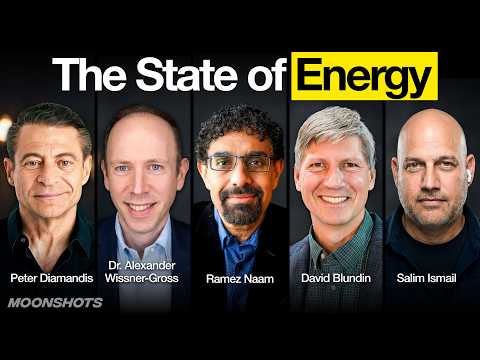
This Moonshots panel, led by Peter Diamandis, brings energy investor and computer scientist Ramez Naam into a discussion about the infrastructure behind AI’s growth. Naam’s central claim is that electricity is cheap beside GPUs, but getting large amounts of power through the grid can take years. The conversation moves from interconnection delays and behind-the-meter generation to solar, storage, nuclear deployment, and a final uncertainty: better algorithms may reduce how much energy AI needs.
Grid access, not electricity price, is AI’s bottleneckSection 02
The speakers argue that electricity is a small cost beside GPUs, so AI companies will pay more for power they can use immediately. The binding constraint is the grid’s slow poles, wires, permitting, and interconnection process.
- The discussion estimates that chips account for about $35 billion of a $50 billion gigawatt-scale data centre, making electricity comparatively cheap.
- The speakers say an AI company would accept power at twice the price if it were available tomorrow because the revenue opportunity outweighs the electricity premium.
- They distinguish fast generation buildouts from the slower poles, wires, permitting, and interconnection work needed to deliver that power.
- Load-side connection waits are also lengthening as large data-centre requests enter already constrained regional queues.
Behind-the-meter generation can bypass grid delaysSection 03
Data-centre developers can build generation on site when utility connections take years, even when that power costs more. Smaller turbines and grid-flexibility software offer nearer-term capacity while large equipment remains backlogged.
- Large natural-gas turbines are described as sold out for roughly seven years, pushing buyers toward smaller equipment that can arrive sooner.
- Developers can justify building their own more expensive power because electricity remains a small fraction of total AI infrastructure cost.
- Investment in flexible data-centre loads can also extract more usable capacity from the grid that already exists.
Solar and storage can win on speed and scaleSection 04
Falling solar and battery costs make firm renewable power increasingly plausible for data centres, and the projects can be built quickly. Seasonal output, rather than daily storage or unit cost alone, remains the hard limit in many locations.
- The speakers cite a more than thousandfold decline in solar-module prices and a fourteenfold decline in battery prices since 2010.
- They describe solar-plus-battery plants as already affordable and say a project can be completed in about twelve months.
- A United Arab Emirates project is presented as guaranteeing one gigawatt continuously by combining five gigawatts of solar with nineteen gigawatt-hours of batteries.
- The remaining solar constraint is winter seasonality, which may require heavy overbuilding or storage that can bridge months rather than hours.
Fission and fusion still depend on deploymentSection 05
Nuclear technologies could add firm power, but the speakers treat industrial repetition, supply chains, capital cost, and credible timelines as the decisive tests. Fusion progress is real, yet startup schedules and maintenance economics remain uncertain.
- New fission designs are expected to encounter first-of-a-kind problems until repeated builds develop experienced crews, stable designs, and supply chains.
- Small modular reactors move work from bespoke construction into repeatable factory manufacturing because manufacturing can improve with volume.
- More than fifty fusion startups mark a break from the old assumption that fusion would always remain fifty years away.
- The most aggressive fusion target is 2028 while most teams discuss the early 2030s, and the speakers caution that startups routinely overstate speed.
- Cheap fusion fuel would not guarantee cheap electricity if reactor capital and maintenance costs remain high.
AI efficiency depends on how you measure itSection 06
The least predictable relief may come from computing more efficiently rather than supplying ever more power. The speakers contrast the brain’s learning efficiency with the high parallel throughput of GPUs and argue that current AI algorithms still leave major efficiency gains undiscovered.
- The discussion argues that current algorithms still lack learning advantages that evolution built into the brain’s physical and neural architecture.
- A roughly twenty-kilowatt group of GPUs can run hundreds of concurrent inference threads, complicating simple per-device comparisons with a twenty-watt brain.
- The speakers compare energy-intensive model training with the evolutionary and human effort embedded in the data on which those models learn.
Claims & connections
Ramez Naam says solar-plus-battery projects can be delivered in about twelve months
ClaimRamez Naam says a solar-plus-battery power project can be delivered in about twelve months.
Moonshots: Energy, AI, and the GridThe panel estimates a twenty-kilowatt GPU system can produce about 5,000 times a person’s token output
ClaimThe panel estimates that a twenty-kilowatt GPU system can produce about 5,000 times a person’s token output.
Moonshots: Energy, AI, and the GridRamez Naam says long grid waits are pushing data centres toward on-site generation
ClaimRamez Naam says long grid waits are pushing data-centre developers toward on-site generation.
Moonshots: Energy, AI, and the GridRamez Naam cautions that fusion startups tend to overstate delivery speed
ClaimRamez Naam cautions that fusion startups tend to overstate how quickly they can deliver.
Moonshots: Energy, AI, and the GridRamez Naam says grid capacity, not electricity price, is AI’s immediate power bottleneck
ClaimRamez Naam says grid capacity, not electricity price, is AI’s immediate power bottleneck.
Moonshots: Energy, AI, and the Grid