

Bryan Catanzaro On Why NVIDIA Builds Nemotron

- Jobs, GDP, And Economic Growth
- Agents
- AI Engineering, Software, And Developer Tooling
- Open Models
- Policy, Governance, And Geopolitics
- Capital, Markets, And Business Models
- AI Infrastructure, Compute, Chips, And Energy
- Frontier Models And Capabilities
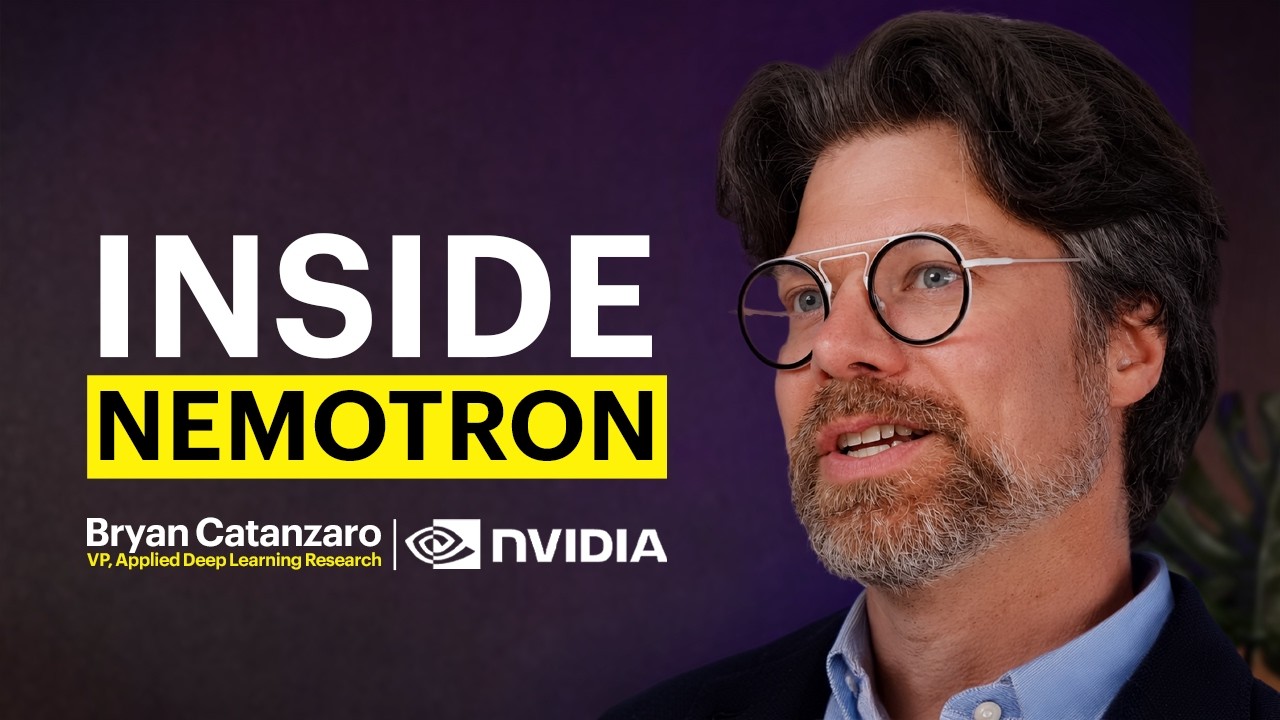
NVIDIA has to deeply understand everything about how AI works. That's how we co-design all of the systems and software for our main product line.
Bryan Catanzaro started at NVIDIA in 2008, when training AI models on GPUs still sounded strange to a lot of machine-learning people. He worked on compilers and libraries for AI on the GPU, including the path that led to cuDNN. Then Andrew Ng asked him to help build Baidu's Silicon Valley AI Lab, where Catanzaro got closer to real AI applications and worked with people including Dario Amodei. Jensen Huang brought him back to NVIDIA in 2016 to build an applied research lab. The first big project became DLSS, using AI to make graphics faster and better. Around the same time, Catanzaro started Megatron because he thought text models would lead to better reasoning. Megatron was a systems project: prove that the largest Transformer models could train on NVIDIA hardware, not only on Google's TPUs. That work became part of the foundation for Nemotron.
That arc explains why NVIDIA builds open models. Catanzaro says Nemotron has two jobs. First, it helps NVIDIA learn what future AI systems need, so the company can build better GPUs, networking, compilers, software, and inference systems. Second, it keeps the open AI ecosystem strong, so companies can build their own AI close to their private data, workflows, customers, and guardrails. The logic is simple: NVIDIA sells the systems AI runs on, so it has to understand the workload from the inside.
Section 1
Section 01- Bryan Catanzaro started at NVIDIA in 2008, when training AI models on GPUs still sounded strange to a lot of machine-learning people. He worked on compilers and libraries for AI on the GPU, including the path that led to cuDNN. Then Andrew Ng asked him to help build Baidu's Silicon Valley AI Lab, where Catanzaro got closer to real AI applications and worked with people including Dario Amodei. Jensen Huang brought him back to NVIDIA in 2016 to build an applied research lab. The first big project became DLSS, using AI to make graphics faster and better. Around the same time, Catanzaro started Megatron because he thought text models would lead to better reasoning. Megatron was a systems project: prove that the largest Transformer models could train on NVIDIA hardware, not only on Google's TPUs. That work became part of the foundation for Nemotron.
Section 2
Section 02- That arc explains why NVIDIA builds open models. Catanzaro says Nemotron has two jobs. First, it helps NVIDIA learn what future AI systems need, so the company can build better GPUs, networking, compilers, software, and inference systems. Second, it keeps the open AI ecosystem strong, so companies can build their own AI close to their private data, workflows, customers, and guardrails. The logic is simple: NVIDIA sells the systems AI runs on, so it has to understand the workload from the inside.
Tags
- AI Infrastructure
- Enterprise AI Adoption
- Developer Tooling
- Coding Agents
- AI Economics
- Open Source AI
- Agent Runtime
- Labor Automation
- Research Labor Productivity
- Agent Orchestration
- Frontier Models
- AI Infrastructure Efficiency
- Test-Time Compute
- AI Policy And Governance
- AI Chips
- AI Capital Allocation
- Software Reliability And Verification
- Economic Growth
- Workflow Automation
- Benchmarks And Evaluation
- Human-In-The-Loop Agents
- Compute Supply Chain
- Enterprise AI Platforms
- Frontier Lab Business Models
- Inference Infrastructure
- Agent Infrastructure
- Post-Training
- Open Weights
- AI Safety Governance