

Gavin Baker says GPU contract repricing can fund hyperscaler AI capex

- Capital, Markets, And Business Models
- AI Infrastructure, Compute, Chips, And Energy

This is a July 28 X post by investor Gavin Baker arguing that the market is overreacting to wider credit spreads for hyperscalers such as Microsoft, Google, Amazon, and Meta. His thesis is that current cash flow understates what these companies will earn because much of their GPU capacity is still priced under older contracts. As those contracts expire and reset at higher rates, he expects operating cash flow to accelerate enough to fund the AI buildout, reduce the need for debt, and pull credit spreads back in.
Why Baker thinks the hyperscaler credit scare is overblownSection 01
The thesisSection 02
Market is overreacting to hyperscale credit spreads widening from my perspective. TL;DR Spot pricing for renting GPU compute materially above contracted rates implies hyperscalers are underearning while operating cash flow acceleration is an underestimated source of funds for AI capex.
Credit spreads measure how much extra compensation investors demand to lend to a company. Wider spreads mean the market sees more risk. Baker thinks that signal is too pessimistic because investors are comparing enormous AI spending with cash flow that has not yet benefited from higher GPU prices.
The missing price signalSection 03
The fact that spot prices for GPU rentals are at least 2x higher than contracted rates is the missing piece from the discussion about hyperscaler credit, which is the only fundamental factor behind this selloff. Multiple private companies are planning on spending at least 2x more per GPU for compute as contracts roll-off and some have spoken about this publicly.
Baker's key evidence is the gap between current GPU rental prices and older contracts. If buyers are prepared to pay at least twice as much when those contracts expire, hyperscalers are currently earning less from their installed capacity than they could at today's prices.
Why operating cash flow should accelerateSection 04
As contracts roll-off, hyperscale growth rates are going to continue to accelerate as their installed bases of compute reprice higher. Hyperscale operating cash flow growth using a mix of estimates and actuals is modeled to accelerate from 31% in the first quarter of 2026 to 50% in the second quarter. This acceleration should continue for the rest of the year and this is not in estimates which incorrectly model a deceleration in the third quarter from my perspective.
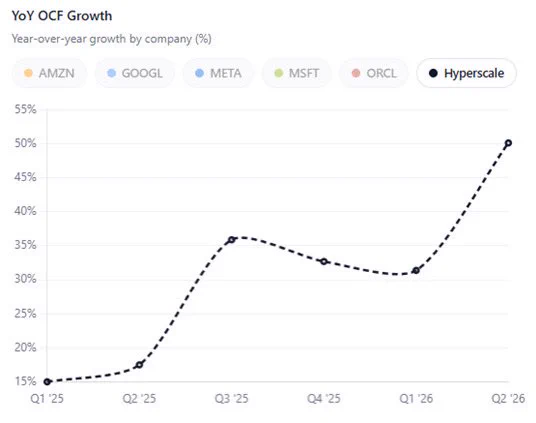
Every contract that resets at a higher price lifts revenue from GPU capacity that is already installed. Baker therefore expects growth and operating cash flow to accelerate without requiring the same increase in physical capacity. His 50% Q2 figure mixes estimates with reported results and represents his model, not a completed quarter for every company.
How contract repricing could fund the AI buildoutSection 05
Baker's capex calculationSection 06
Some math. Consensus estimates are probably for 25-35 gigawatts added by hyperscale and neoclouds in CY28 (using a range as standing up datacenters is hard and a lot of the neos plus labs are still private). At 60b per gigawatt, that is 1.5 to 2.2 trillion in capex. Consensus estimates for hyperscale/neo operating cash flow is 1.3 to 1.4 trillion. I think this gets revised up materially as contracts reprice and growth accelerates so the 100b to 700b that would hypothetically need to be plugged by debt goes away. And their credit profiles materially improve. Not to mention the said 100b to 700b would be less than 1 turn of incremental leverage on consensus EBITDA estimates. And obviously the Nvidia and Broadcom “credit wrappers” help improve creditworthiness as well given their FCF profiles.
Baker starts with 25–35 gigawatts of new 2028 capacity and a cost of $60 billion per gigawatt. He compares the resulting capex estimate with $1.3–$1.4 trillion of expected operating cash flow. The market's concern is that the remaining gap must be funded with debt.
His counterargument is that the cash-flow estimate is too low. If GPU contracts reprice and cloud growth accelerates, he expects the projected $100–$700 billion debt gap to shrink or disappear. He also argues that even the upper end would add less than one turn of leverage, while support from cash-rich Nvidia and Broadcom could improve financing terms.
The figures should be read as Baker's rough ranges rather than reconciled arithmetic: 35 gigawatts at $60 billion equals $2.1 trillion, not $2.2 trillion, and the printed capex, cash-flow, and debt-gap ranges do not align perfectly at every endpoint.
Why Baker expects credit spreads to tightenSection 07
Demand that current free-cash-flow forecasts may missSection 08
OpenAI, Cursor/Grok and the various Open Source inference clouds have accelerated materially over the last two months per public data and Anthropic continues to grow insanely fast while likely generating FCF. This - along with the fact that spot prices for GPU rentals are so far ahead of contract - are the missing pieces from the BofA chart on hyperscale FCF vs. semiconductor FCF.
The BofA chart shows semiconductor free cash flow rising while hyperscaler free cash flow falls under the weight of AI spending. Baker says it is backward-looking because it misses accelerating demand from AI labs and inference providers, as well as the future price increases embedded in expiring GPU contracts. The green projection on the chart is Baker's annotation, not BofA's.
Who is under-earning and who is over-earningSection 09
Hyperscalers are underearning and anyone who signed a contract for GPU compute in 2024 and 2025 is overearning. Operating cash flow will be enough to fund capex but as contracts reprice and cloud growth continues to accelerate then spreads likely come in as well.
Customers that locked in GPU capacity during 2024 or 2025 are paying less than today's rental rates, so Baker calls them the current winners. Hyperscalers are the other side of those contracts. When the agreements reset, he expects more of the economic value to move back to the infrastructure owners, lifting cash flow and reducing perceived credit risk.
Why Baker discounts the CDS warningSection 10
Would also note that CDS markets are easy to manipulate - was a huge feature of the GFC - short the stock and then buy the CDS. So I would not put attach much signal to CDS.
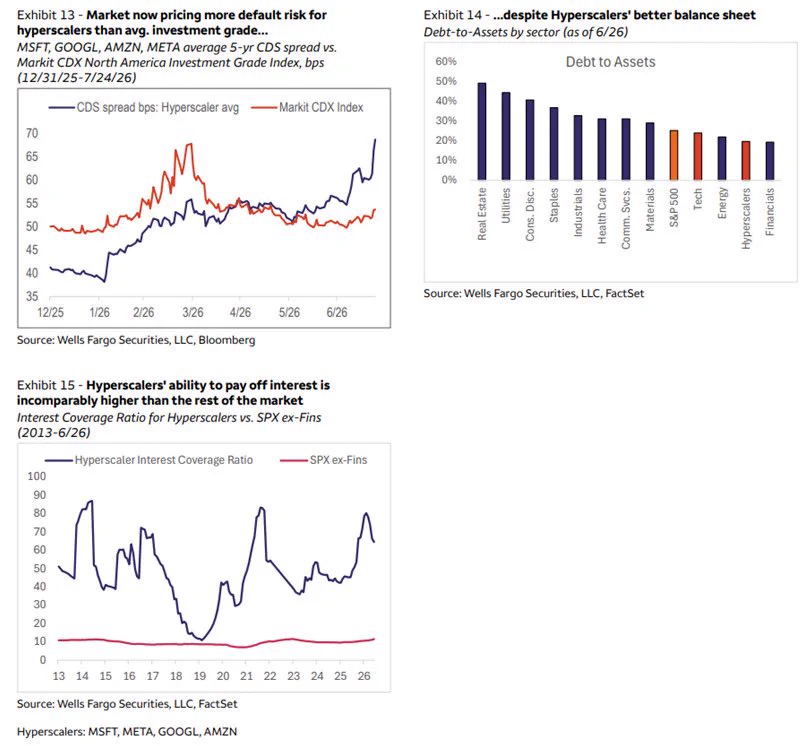
A credit-default swap is insurance against a borrower failing to repay. Buying more protection pushes its price higher and can make the market appear more worried. Baker argues that this signal can be distorted, so he gives more weight to hyperscalers' balance sheets, interest coverage, and future cash generation.
The risk Baker does take seriouslySection 11
Net, net I’m not that concerned about the widening spreads in hyperscale credit. The real risk is that bringing power online and energizing all these GPUs is really hard but we are getting better at this every day.
Baker's conclusion is not that the AI buildout is risk-free. He thinks the financial risk is being overstated, while the physical execution risk is real: data centres need grid connections, generation, equipment, and enough power to run the GPUs already being purchased.
Tags
- AI Infrastructure
- Data Centers And Energy
- AI Capital Allocation
- Cloud Economics